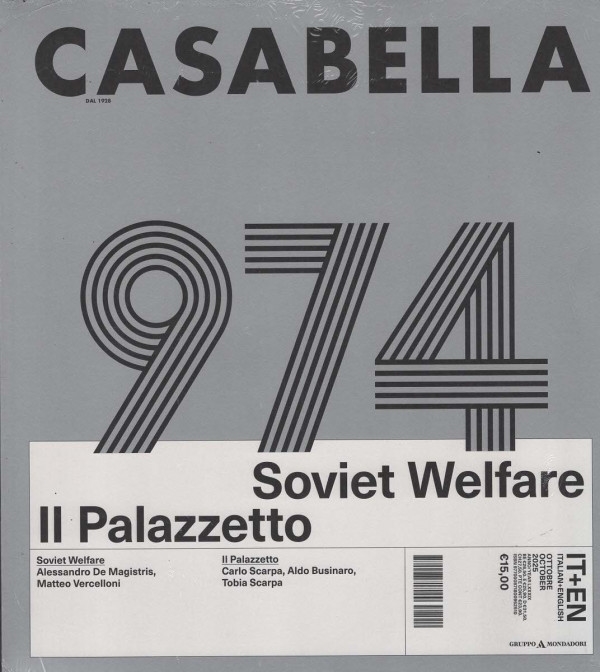
Casabella - 974 oct. 2025
16/12/2025
XXVI + 102 p.
0008-7181
Pour la Russie, la Crimée a longtemps représenté une porte d'entrée vers les mers chaudes et le théâtre de ses ambitions impériales. Peu de choses ont changé depuis la naissance de l'Union soviétique, et aujourd'hui encore, la persistance du totalitarisme russe y trouve son terrain d'expression. Parmi les vestiges de ce paysage, outre les ruines quotidiennes de la guerre, se dressent les ruines d'édifices jadis érigés pour célébrer le « nouveau monde » que le socialisme s'était imaginé.
La première partie de ce numéro 974 de « Casabella » raconte l'histoire d'un ensemble de ces bâtiments – sanatoriums, maisons de repos, stations thermales, pâtisseries, aires de jeux, etc. – qui, à l'instar de ceux de Crimée, furent construits en Géorgie voisine dans un but social similaire. Ces projets impliquaient souvent des architectes de renom qui contribuèrent à façonner le mythe de l'avant-garde soviétique des années 1920. Plus récemment, ces bâtiments ont cessé d'être des lieux de loisirs ou de soins pour les citoyens soviétiques et sont devenus les témoins de naufrages individuels et collectifs.
Nombre de ces lieux ont été occupés par des réfugiés fuyant la guerre entre la Géorgie et l'Abkhazie, qui a débuté en 1992 – un fragment oublié d'une histoire qui se poursuit encore aujourd'hui. De même que le totalitarisme soviétique réduisait jadis les êtres humains à de simples instruments de la nécessité historique, la bestialité humaine réduit aujourd'hui les individus et leurs œuvres à l'état de ruines.
Après avoir parcouru ces premières pages, le lecteur pourrait trouver la transition vers la seconde partie de « Casabella » 974 quelque peu déconcertante. Pourtant, la bestialité (Bastialität) n'est pas le seul destin de la modernité. « Les actions humaines, écrivait Hannah Arendt, sont totalement arbitraires, et le droit et les rapports de pouvoir ne peuvent que fixer les limites au-delà desquelles opère cette sphère de vie entièrement différente qui n'est pas publique.» À cette sphère appartiennent les choses que les hommes créent parfois librement, par-delà la nécessité – arbitrairement, pourrait-on dire.
C'est cet esprit qui s'incarne dans ce que Carlo Scarpa a réalisé lorsqu'il a transformé une vieille maison de campagne en « petit palais » présenté dans ce numéro de « Casabella » 974. L'histoire de cette remarquable transformation est racontée en parallèle de celle de son propriétaire, Aldo Businaro, qui a transformé la maison en un musée fascinant et non conventionnel du design contemporain.
ottobre 974 october
Sommario / Summary
2
Consenso e arbitrio /Consensus and arbitrariness
Francesco Dal Co
3-45
Soviet Welfare
5
‘Playtime' à la soviétique. Per un'archeologia del tempo libero ‘proletario' / Towards an archaeology of ‘proletarian' free time
Alessandro De Magistris
25
Sanatorio Megobroba / Megobroba Sanatorium
27
Stabilimento Termale n. 5 / Bathhouse n. 5
28
Sanatorio Savane / Sanatorium Savane
29
Sanatorio Metalurgh / Metalurgh Sanatorium
32
Stabilimento Termale n. 6 / Bathhouse n. 6
34
Sanatorio Gelati / Gelati Sanatorium
39
Sanatorio Medea / Medea Sanatorium
41
Stazione Ferroviaria / Rail Station
43
Stabilimento Termale n. 8 / Bathhouse n. 8
44
Sanatorio Aia / Aia Sanatorium
46-97
Carlo Scarpa, Aldo Businaro, Tobia Scarpa.
Il Palazzetto
48
Carlo Scarpa, Aldo Businaro e il Palazzetto nei miei ricordi / Carlo Scarpa, Aldo Businaro and il Palazzetto: my memories
Guido Pietropoli
52
Il Palazzetto: il percorso nella successione delle immagini e i progettisti degli interventi / Il Palazzetto: the sequence of images and the designers of the interventions
Casabella
87
Vite intense. Frammenti di creatività / Intense lives. Fragments of creativity
Massimo Curzi
98-102
Biblioteca/Books
98
Biblioteca / Books
99
Les Mystères du Château du Saint-Cloud
Francesco Dal Co
La Crimea ha rappresentato per la Russia la porta verso il “mare caldo” e la sua proiezione imperiale. Le cose non sono cambiate dopo la nascita dell'Unione Sovietica e ancora oggi il potere di rigenerarsi del totalitarismo russo ha in Crimea il suo palcoscenico. Tra le sue quinte vi sono, oltre alle rovine che ogni giorno vengono lì accumulate, anche quelle di opere di architettura costruite per celebrare il “mondo nuovo” con il quale il Socialismo si identificava. Nella prima parte di questo numero, «Casabella» 974 racconta la storia di un insieme di edifici (sanatori, case di riposo, terme, pasticcerie, parchi giochi ecc.) che, come in Crimea, vennero costruiti con analoghe finalità nella non lontana Georgia.
Ciò avvenne coinvolgendo anche architetti celebri e che hanno contributo a rendere un mito l'avanguardia sovietica degli anni Venti. In tempi più recenti, queste architetture non più luoghi di cura e di svago per i cittadini sovietici, ma relitti dei naufragi individuali e collettivi di quanti le avevano originariamente volute e progettate, hanno accolto i rifugiati dalla guerra tra la Georgia e l'Abkhazia iniziata nel 1992, una parte dimenticata di una storia che continua: come il totalitarismo sovietico si identificò con la riduzione dell'uomo a strumento del compiersi della storia, così ai nostri giorni è la natura bestiale dell'umanità a ridurre l'uomo a semplice materiale e le sue opere a ruderi.
Una volta sfogliate le prime pagine, alcuni lettori potrebbero ritenere sconcertante il loro accostamento alla seconda parte di «Casabella» 974. Ma la bestialità (Bastialität) non è il solo destino della modernità. «Le azioni umane», spiega Hannah Arendt, «sono completamente arbitrarie e la legge e le relazioni di potere possono stabilire solo i confini oltre i quali opera quella sfera della vita completamente diversa che è non pubblica».
A questa sfera possono appartenere anche le cose che gli uomini a volte costruiscono liberi dalla necessità, arbitrariamente, come ci auguriamo dimostri quanto Carlo Scarpa ha fatto trasformando una vecchia casa nel “piccolo palazzo” di cui «Casabella» 974 racconta la storia, insieme a quella del suo proprietario, Aldo Businaro, che l'ha trasformato in un suggestivo ed eterodosso museo del design contemporaneo.
Francesco Dal Co
For Russia, Crimea has long represented a gateway to the “warm sea” and a stage for its imperial ambitions. Little has changed since the birth of the Soviet Union, and even today the lingering vitality of Russian totalitarianism still finds its theatre there. Among its backdrops, besides the daily ruins of war, stand the remnants of buildings once erected to celebrate the “new world” that socialism imagined for itself.
The first part of this issue of «Casabella» 974 tells the story of a group of such buildings — sanatoriums, rest homes, spas, patisseries, playgrounds and more — that, like those in Crimea, were constructed in nearby Georgia with similar social purposes. These projects often involved renowned architects who helped shape the myth of the Soviet avant-garde of the 1920s. In more recent times, these buildings have ceased to be places of leisure or care for Soviet citizens and have instead become the wreckage of both personal and collective shipwrecks.
Many have been taken over by refugees from the war between Georgia and Abkhazia that began in 1992 — a forgotten fragment of a story that continues to this day. Just as Soviet totalitarianism once reduced human beings to instruments of historical necessity, so now the bestiality of humankind reduces both people and their works to mere ruins.
After leafing through these opening pages, readers may find the transition to the second part of «Casabella» 974 somewhat disconcerting. Yet bestiality (Bastialität) is not the only fate of modernity. «Human actions», wrote Hannah Arendt, «are completely arbitrary, and law and relations of power can only set the limits beyond which operates that entirely different sphere of life which is not public. » To this sphere belong the things that people sometimes create freely, beyond necessity — arbitrarily, one might say.
This is the spirit embodied in what Carlo Scarpa achieved when he transformed an old country house into the “small palace” featured in this issue of «Casabella» 974. The story of this remarkable transformation is told alongside that of its owner, Aldo Businaro, who has turned the house into a fascinating and unorthodox museum of contemporary design.
Francesco Dal Co
URL lien : https://casabellaweb.eu/2025/10/31/ottobre-974-october/
N° revue : 974 oct. 2025